
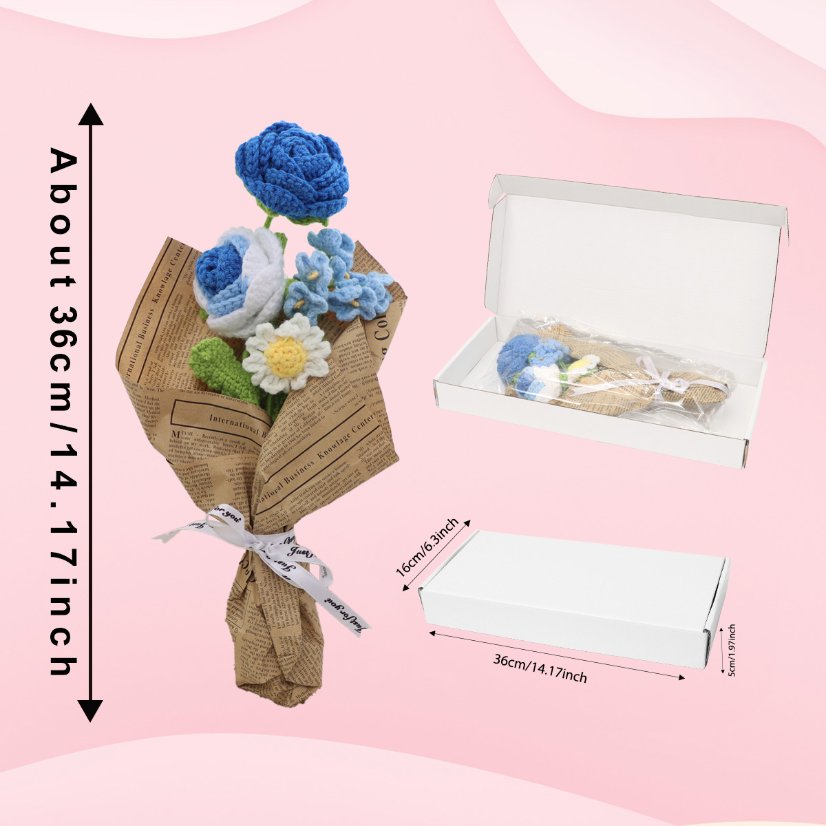
A bouquet box RFQ should identify the exact arrangement being packed, the proposed box and the state in which each dimension is measured. Ask the supplier to connect the packing example to the offered product revision. Guiyuan Crafts’ MXB02 board illustrates an open and closed box, but the catalogue layout does not by itself confirm inclusion, inside clearance or protection in transport.
Identify the arrangement before selecting a box reference
Buyers reviewing wholesale yarn bouquets should keep the actual product model beside every packing question. Attach the MXB02 link and the selected packing board, then ask which offered arrangement the supplier proposes to pack. A box shown with one catalogue product should not silently become the confirmed package for another arrangement.
Keep a changed bouquet version separate until its packing proposal is answered. A difference in wrapping, arrangement or included items may change the object being packed. This article does not decide those supply contents. It asks for a packing record that accurately represents whichever version the quotation actually offers.
Give the proposed box its own identity
Ask the supplier to identify the box reference rather than responding only that a gift box is available. Keep the proposal’s opening style and included packing components identifiable in the record. Do not infer a particular board material, lining, insert or closure from a white box illustration.
If the supplier proposes another package, retain it as an alternative with its own reference. Ask whether it is included in the offer or quoted separately. The enquiry can then compare actual proposals without presenting the catalogue illustration as a confirmed commercial packing specification.
Packing record | Question to resolve | Evidence requested
Bouquet version | Which offered arrangement is packed? | Model and revision reference
Box identity | Which actual proposed box? | Supplier reference and description
Measured state | Open, closed, empty or filled? | Named state on the record
Dimension basis | Inside, outside or another boundary? | Marked endpoints and units
Packing example | Does it represent this offer? | Identified view linked to the revision
Open question | What remains unconfirmed? | Explicit supplier reply or alternative
Separate inside and outside measurements
A dimension printed beside a box can be ambiguous unless its boundaries are named. Ask whether the value describes the inside space, outside package or another stated reference. Keep those fields separate if more than one is needed. Do not estimate a missing clearance by measuring the catalogue image on a screen.
Ask the supplier to mark the endpoints and retain units on every value. Keep the original returned dimensions beside any buyer conversion. A conversion does not resolve an unnamed measuring state or make an outside measurement equivalent to an inside one. Any tolerance or acceptance range needs a separate response; no default is supplied here.
Record the actual proposed packed state
Request an identified example showing how the offered bouquet is positioned in the proposed box. Ask the supplier to name the example and the product revision it represents. If the image shows a wrapper, bag or other packing component, record it and request its actual inclusion scope rather than silently adding it to the offer.
Keep the open view and the closed view connected to the same example where both are supplied. A closed box alone cannot show the arrangement inside it. Likewise, a catalogue image of an open package does not establish how a particular commercial order will be packed. The supplier’s response should make that connection explicit.
Keep packing observations apart from protection claims
If a packing sample is received, record what the reviewer actually observes on opening it. Identify any location requiring clarification and retain a view that lets the supplier understand the question. Do not assign the cause of a mark or infer shipping performance from an isolated photograph.
A packing layout is not a transit-test result, a guarantee against crushing or a statement about long-term product condition. Keep any required performance question separate. The useful purchasing output is an identified proposed package, a readable measurement basis and an example linked to the offered version.
• Keep bouquet and box identifiers together.
• Name the state and boundaries of every measurement.
• Connect the packing example to the same offered revision.
• Retain unanswered fields without inventing materials or protection results.
Send a packed-version request
An RFQ can read: For the identified MXB02 offer, please describe the box proposed and provide an example linked to that product revision. State whether each measurement is inside or outside and name the measured state. Identify the packing components shown and mark alternatives or unanswered fields. Please keep the catalogue reference separate from the actual offer. Use Guiyuan Crafts’ product and contact links with the request.
Frequently asked questions
Does the illustrated box confirm order inclusion?
Ask the supplier to identify the actual packing offer and its commercial inclusion scope. A catalogue illustration alone does not settle that question.
Can outside dimensions confirm inside clearance?
Keep those measurement bases separate. Request marked boundaries and the actual proposed packed example where clearance matters.
Does a packing sample prove transport protection?
It supports observations of that example. Protection or shipping-performance claims require separately identified evidence.
Product and contact references
https://gycrafts.com/product/product-2/
https://gycrafts.com/product/product-3/
https://gycrafts.com/contact/
https://gycrafts.com/blog/